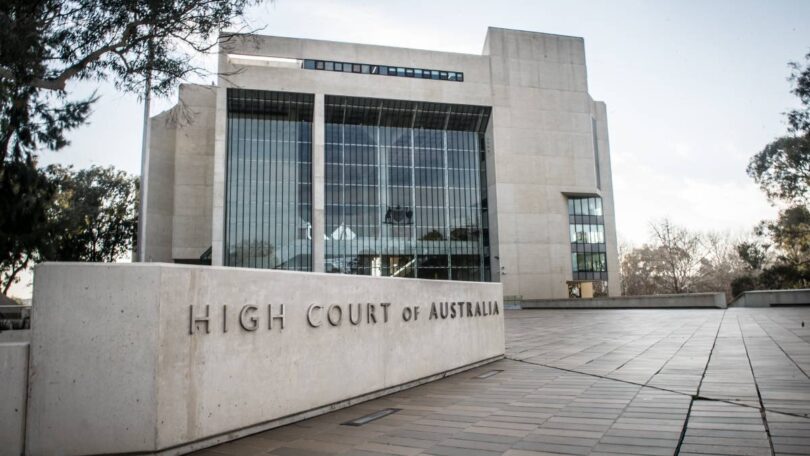

Queensland’s new laws banning pro-Palestine slogans face an imminent High Court challenge, backed by a landmark ruling that found suppressing political speech is unconstitutional.
More than 20 people were arrested in Brisbane on April 18 for reciting or displaying the banned phrases.
The offences carry a maximum penalty of two years’ jail under laws introduced by the Queensland government earlier this year.
The arrests follow a NSW Court of Appeal ruling that found discouraging public assembly to maintain social cohesion was unconstitutional because of Australia’s freedom of political communication.
Constitutional expert Professor Anne Twomey said the Queensland law’s survival would likely hinge on the purpose given to it by the High Court.
“If the purpose is to suppress particular political expressions based on content to achieve social cohesion, it may be found illegitimate,” she said.
Even if the law cleared the legitimate purpose threshold, Prof Twomey said it could still be considered unfair at the High Court.
Activist Alex Bainbridge, 54, said lawyers for those arrested were preparing a High Court challenge, with full details to be announced within weeks.
Mr Bainbridge criticised the Queensland laws as extreme, harsh and poorly planned.
He said there was a good chance the laws would be struck down, but the state government could introduce new laws the following day.
Arrested protester Mark William Gillespie, 70, said the new laws had dangerously shifted the legal threshold for what constitutes criminal speech.
“They’ve shifted the goalposts. Once you had to actually hurt somebody with your language and now it’s that somebody might take offence,” Mr Gillespie said.
Gillespie will plead not guilty when he faces court on May 19, with lawyers expected to seek a delay pending the High Court challenge.
University of Sydney academic Dr Martin Kear said banning the phrases was simply the easiest and least politically damaging option for governments.
“I don’t think any government in a democracy should dictate which version is legitimate. To ban the phrase is to ban the debate,” Dr Kear said.
He said the bans effectively outlawed debate over Palestinian statehood and Israeli occupation, making criticism of Israel harder to mount.
Ms Twomey said that unlike NSW’s outright ban on protest, Queensland’s law targets slogan use likely to cause public menace, harassment or offence.
Mr Bainbridge said the legal crackdowns were a response to the Palestine solidarity movement, which had produced the largest consistent protests since Vietnam.
“What the NSW court result shows is that when governments go too far, the judiciary will step in and basically stop them,” he said.
Gillespie said existing laws against urging violence were already enough and did not require the new phrase-specific offences introduced by Queensland.
Mr Bainbridge said only direct incitement to violence might justify some legal consequences for words, but that context was entirely absent from these bans.
Dr Kear said the primary motivation behind banning the phrase was to make criticism of Israel more difficult.