
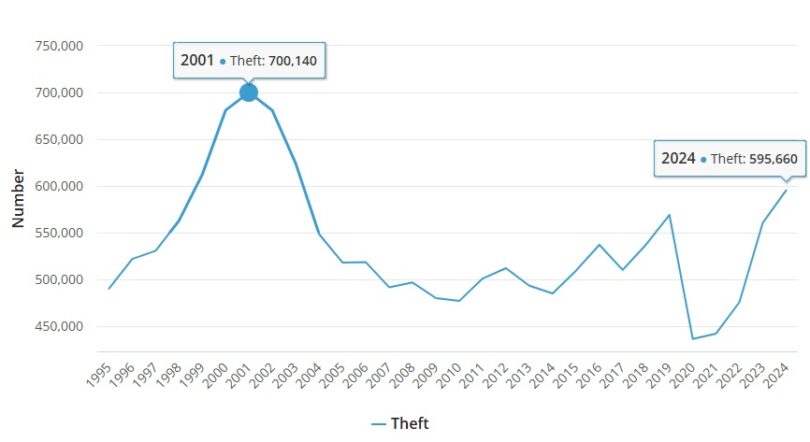

(Image: ABS.)
I was in a 7/11 when a homeless person walked in. The employee cried out in protest, then tried to body-block the man from going further into the store. The homeless man then took a drink, and walked out without paying.
I talked to the employee, and he told me this person was a repeat thief. He also confirmed the man’s homelessness by saying he sleeps just up the road. The employee also told that that because the man is homeless, there is nothing the law could do to punish him, and that the employee himself is extremely limited in what he could do.
Unfortunately, I’m witness to instances like this on an almost daily basis.
Almost every time I go to the grocery store, I see people shoplifting. It’s usually young people, stealing small things like energy drinks and lollies. This, together with the incident in 7/11, hinted that it’s a broader issue than simply the law having little to no way to punish destitute shoplifters.
I knew there was a story here, so I started asking around.
I quickly learned that employees, including contracted security, weren’t allowed to talk about their experiences due to store policy and due to confidentiality clauses. It’s hard to fact check this in regards to security, because these companies contract their employees through a separate body, and the administrators don’t seem to speak English very well. They are also hard to get in touch with.
So I kept searching for people willing to talk with the promise of anonymity, and in the meantime, I researched.
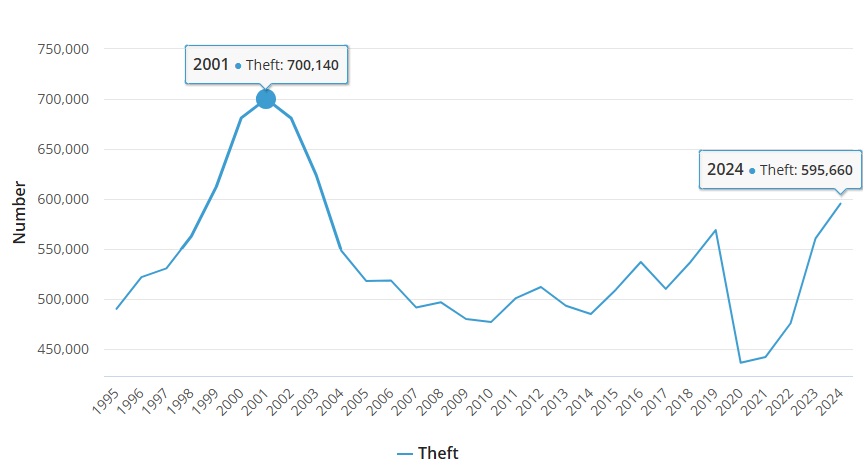
Woolworths Group told The Australian that they lose $9 billion a year, and the Australian Institute of Criminology reports (AIC) that loss in sales caused by shoplifting can account for 25% of profit loss for the business. Meanwhile, Victoria reached a 21 year high in crime according to the Crime Statistics Agency (CSA) Theft, which includes both residential and retail theft, was up 27.6% in 2025 from the previous year, and was the main driver for the increase in crime.
(Source: ABS.)
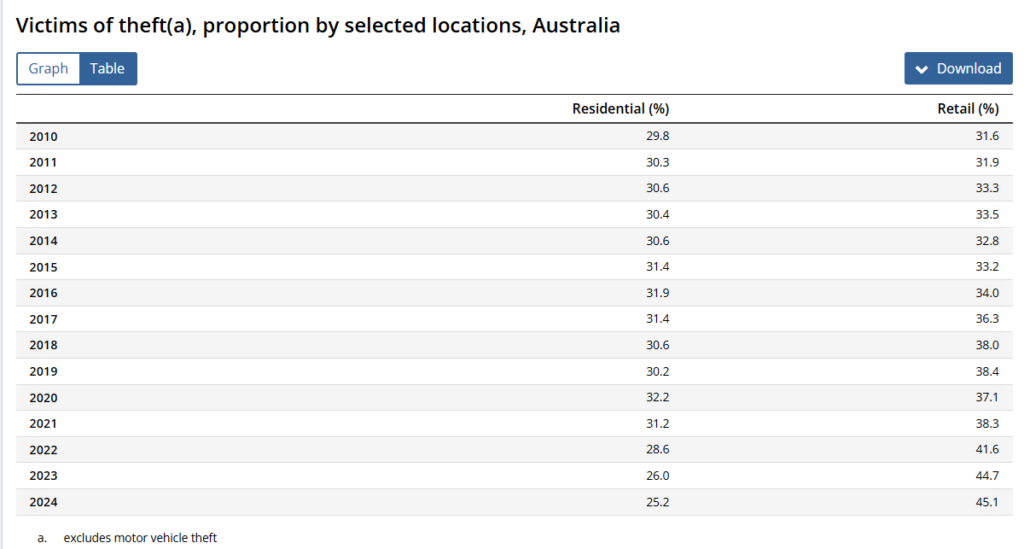
(Source: ABS.)
I did manage to find two retail workers willing to talk, but they requested their identities remain anonymous. One, a security team member, and the other a retail team member.
This first interview was a vox pop with a security guard, which had to be cut short to retain his identity.
This second interview was with a retail team member, who also asked to remain anonymous.
The main drivers of the conversation seem to be three things: Preventative measures, punishments, and incentives to not steal.
There’s a few issues here. One is that security can’t restrain people, and though they can request bag checks, customers can refuse and leave.
According to RMIT lecturer and economist Dr. Martin Byford, low cost items have a correlation with abundance. He also said that preventative measures get to a point where letting the item in question get stolen is cheaper than implementing preventative measures, such as security tags and security personnel.
According to the AIC, retail theft is a prevalent issue, but measurements are poor, which can be due to stores having more of a focus on retrieving stolen items from shoplifters rather than reporting it.
On that note, and according to the Victorian Sentencing Act 1991, it makes sense that the severity of the crime scales with the punishment, as preventative measures are more costly and perhaps not worth it if the item is lower cost. According to the CSA, the most stolen items are groceries and clothes, and the least stolen is jewellery, with electronics in the middle. It seems instances of theft correlates with value, as lower value items get stolen more often than higher value items.
As an academic economist, Dr. Byford has 20 years of research experience in the fields of industrial organisation.
Dr. Byford offers his perspective on Melbourne shoplifting culture, on destitution, and its effects on the retail sector.
While large retail chains lose billions of dollars a year, small local businesses will have a harder time keeping up with the loss in profit caused by potential shoplifting, and that also means the cost of other stock will rise as a result. As it stands, there is little to no legal incentive for people with low socioeconomic status to refrain from stealing lower cost items, and there seems to be no way for business owners to stop shoplifters. With stores that stock higher cost items, there is an incentive for a company to ask its employees to take the legal risk and prevent shoplifters, but that incentive doesn’t exist for grocery stores and general clothing stores.
This brings up some interesting questions. If the issue is to be fixed, what needs to change: The law, or the culture? Both? And how?
